Create your own ecommerce website and start selling successfully with ShopWired today


The end of the $800 duty-free threshold: What UK ecommerce businesses must know
General Ecommerce Advice
On 29 August 2025, a major change comes into effect that will reshape the way UK retailers sell to customers in the United States. The U.S. government is removing its long-standing de minimis exemption, which has until now allowed parcels valued at under $800 to enter the country free of duties and with minimal customs procedures. For years this threshold has been a lifeline for international e-commerce, enabling UK businesses of all sizes to serve American customers without the burden of tariffs, complex paperwork, or delays at the border. The removal of this exemption is not a minor regulatory tweak. It represents a fundamental shift in the economics of cross-border trade. Every shipment, no matter how small, will now be subject to U.S. customs entry, duties, and compliance requirements. A single £20 product ordered by a customer in New York will face the same scrutiny as a bulk consignment imported by a wholesaler. The result will be higher costs per parcel, longer delivery times, and more administration for sellers. For UK e-commerce businesses, the stakes are high. The United States is the world’s largest consumer market and, for many online retailers, a crucial source of growth. But the ease of reaching American customers is about to change. Without preparation, UK sellers risk unhappy customers faced with unexpected import bills, or worse, orders that are refused at the border. This article explains what the de minimis exemption was, what its removal means in practice, and how UK retailers can adapt. We will cover the legal and compliance requirements, the commercial impacts across key product categories, and the practical steps you can take now to protect your U.S. sales. The aim is not simply to outline the problem, but to provide clear, actionable guidance so that your business is ready for this new trading environment.Introduction
Table of Contents
- What Is the De Minimis Exemption?
- What’s Changing and When?
- Why This Matters for UK Retailers
- Legal, Tax and Compliance Requirements
- Impact on UK Retailers: Costs and Operations
- Sector-Specific Impacts
- B2C vs B2B Implications
- Adapting Your Business Strategy
- Short-Term Actions (Before and After August 2025)
- Longer-Term Outlook
- Expert and Trade Body Insights
- Checklist for UK Retailers
- Conclusion
What Is the De Minimis Exemption?
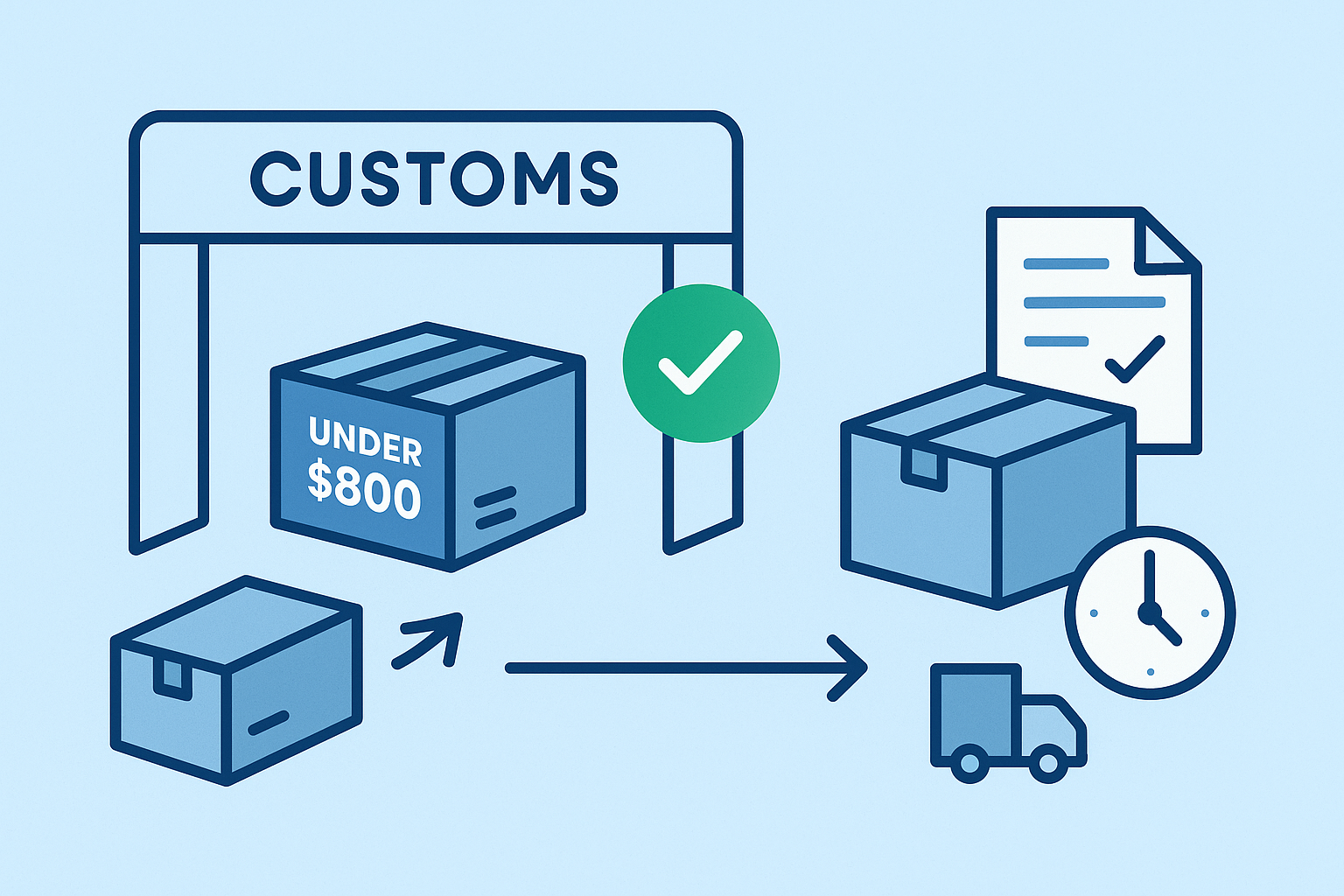
In international trade, the term de minimis refers to a value threshold below which imported goods can enter a country without the payment of duties and with simplified customs procedures. Each country sets its own threshold, and in most cases the allowance is relatively low. The United Kingdom, for example, applies a £135 threshold for imports before customs duties are charged. The European Union has set its limit at just €150 for duties and effectively zero for VAT.
The United States has historically had one of the most generous de minimis regimes in the world. Since 2016, parcels valued at up to $800 have been allowed into the U.S. duty-free and without formal entry paperwork. This meant that a UK retailer could send a small order directly to an American customer with very little friction: no import duty, minimal customs clearance, and fast transit through U.S. border checks.
This exemption transformed the global e-commerce landscape. U.S. Customs and Border Protection has in recent years been handling millions of such parcels every day, many of them coming from international online sellers. For UK retailers it opened the door to the American market without requiring warehouses, distributors, or complex tax arrangements in the U.S. Even a boutique brand could sell direct to U.S. consumers, confident that the products would arrive quickly and without extra costs at delivery.
From 29 August 2025, this exemption is being removed. Every package, regardless of its value, will be treated as a formal import into the United States. Understanding the importance of the de minimis threshold, and how its removal alters the economics of cross-border trade, is the first step in preparing your business for the changes ahead.
What’s Changing and When?
From 29 August 2025, the United States will suspend its $800 de minimis threshold for all imports, regardless of their origin, shipping method, or declared value. This means that every parcel entering the U.S. will require a full customs entry and will be subject to applicable duties, taxes, and clearance fees. The days of sending a low-value order to an American customer with no duty and minimal checks are coming to an end.
Until now, only certain countries were affected. In May 2025, the U.S. had already removed de minimis benefits for shipments originating from China and Hong Kong, largely in response to concerns about counterfeit goods and illicit products. From August, however, this policy will extend to all countries, including the UK. No retailer, no matter their size or location, will be exempt.
There is a temporary grace period for parcels sent through the international postal system (Royal Mail, Parcelforce, USPS). For six months after 29 August, these shipments can use a simplified system that applies a flat per-parcel duty, typically set between $80 and $200 depending on the origin and product type. This interim arrangement is designed to give postal networks time to adapt to the new rules. After this period, expected to end in early 2026, even postal parcels will be subject to full ad valorem duties and the same customs requirements as courier shipments.
For businesses that use express couriers such as DHL, UPS or FedEx, the change applies immediately on 29 August. These carriers will require full customs data and will charge duty and brokerage fees on every consignment from day one. Retailers relying on these services should therefore be prepared for an instant increase in both administrative requirements and customer costs.
The U.S. government has justified the policy shift on several grounds: closing loopholes that allowed undervaluation of goods, preventing the flow of counterfeit and unsafe products, and levelling the playing field for domestic retailers who face duties when exporting abroad. While these objectives are understandable from a U.S. perspective, the result for UK exporters is clear: cross-border trade into the U.S. will become more complex, more expensive, and more time-consuming from late summer 2025 onwards.
Why This Matters for UK Retailers

For UK retailers, the United States is a vital export market. It is the world’s largest consumer economy, with a high appetite for international products and strong demand for British fashion, beauty, homeware, and specialist goods. Until now, the $800 de minimis threshold has made selling directly to American customers simple and profitable. Orders could be fulfilled from the UK, sent by post or courier, and delivered to the buyer without additional duties or unexpected costs. That advantage disappears in August 2025.
The removal of the exemption matters because it changes the economics of every single order. What once cost the customer only the item price and shipping will now attract import duty, clearance charges, and potentially state sales tax. Even modest duties of 10–15% can wipe out margins on certain products, and clearance fees of $10–20 per parcel become highly significant on low-value orders. For price-sensitive shoppers, this can be the difference between completing a purchase and abandoning it.
Delivery speed is also affected. Without the simplified customs process, shipments will need to be declared, assessed, and sometimes inspected. Retailers who have been able to promise five-to-seven day delivery may find transit times doubling, especially during the initial implementation period. Customer expectations for quick, frictionless delivery mean that these delays will impact satisfaction and repeat purchasing.
Operationally, UK businesses must now treat every U.S.-bound parcel as a formal export. That requires accurate product classification, proof of origin, and the correct documentation for regulatory compliance. Small businesses that have never dealt with U.S. customs before will face a steep learning curve. Mistakes in valuation or labelling can lead to fines, seizures, or delays at the border.
In short, this change matters because it affects costs, competitiveness, and customer experience. Retailers who do not adapt risk losing U.S. sales altogether. Those who act now—by adjusting logistics, pricing, and communication—stand the best chance of retaining their American customer base and turning disruption into opportunity.
Legal, Tax and Compliance Requirements
With the end of the U.S. de minimis threshold, every order shipped from the UK to an American customer must now be treated as a formal import. This creates new legal obligations and compliance steps that retailers cannot ignore. Failing to follow the correct procedures risks delays, unexpected costs, or even fines and seizure of goods.
Customs Entry and Documentation
Every parcel must be accompanied by a detailed commercial invoice. This includes an accurate description of the goods, their value in USD, the correct Harmonized Tariff Schedule (HTS) code, and the country of origin. In the past, many small orders passed through customs with little more than a shipping label. That will no longer be sufficient.
Duties and Tariffs
Import duties now apply to all shipments, regardless of value. The rate depends on the HTS code and the origin of the product. For example:
- Apparel can face tariffs of 10–25% or more, depending on fabric and style.
- Beauty and skincare products are typically in the 4–15% range.
- Electronics vary widely: many laptops and phones are duty-free, but accessories often face 5–10%.
- Supplements and vitamins are generally low duty but still require full customs entry.
If goods are manufactured outside the UK, duties may be even higher. For example, products of Chinese origin can attract additional U.S. tariffs of up to 25% on top of normal rates.
Brokerage and Clearance Fees
On top of import duty, couriers will charge a clearance fee for processing the customs entry. This is typically $10–20 per shipment, a cost that quickly erodes margins on low-value orders. Postal shipments may also carry a fixed duty during the six-month grace period, usually between $80 and $200 per parcel, depending on the tariff category.
Importer of Record
Every shipment must have an importer of record in the U.S.—either the customer, the courier, or the retailer through a customs broker. If the importer is the customer, they are responsible for paying duties before delivery. If the retailer opts to act as importer, they can use a Delivered Duty Paid (DDP) model, ensuring the parcel arrives without further charges but taking on the duty cost themselves.
Regulatory Compliance
Formal entry brings U.S. regulatory agencies into play. Depending on the product, additional requirements may apply:
- FDA – cosmetics, supplements, and food products must meet FDA standards and may require prior notice.
- FCC – electronics with wireless capability must be certified for U.S. use.
- CPSIA – children’s products must comply with safety and labelling rules.
Retailers should ensure their goods meet U.S. regulatory requirements before shipping, as customs checks will now be routine.
Penalties for Non-Compliance
Attempting to avoid duties—such as undervaluing shipments or splitting orders—can result in fines of up to $5,000 for a first offence and $10,000 for subsequent offences. U.S. Customs has made clear that enforcement will be strict once the exemption ends.
In short, compliance is no longer optional or avoidable. UK retailers must prepare to handle the same level of customs scrutiny that large importers face, even for the smallest orders.
Impact on UK Retailers: Costs and Operations
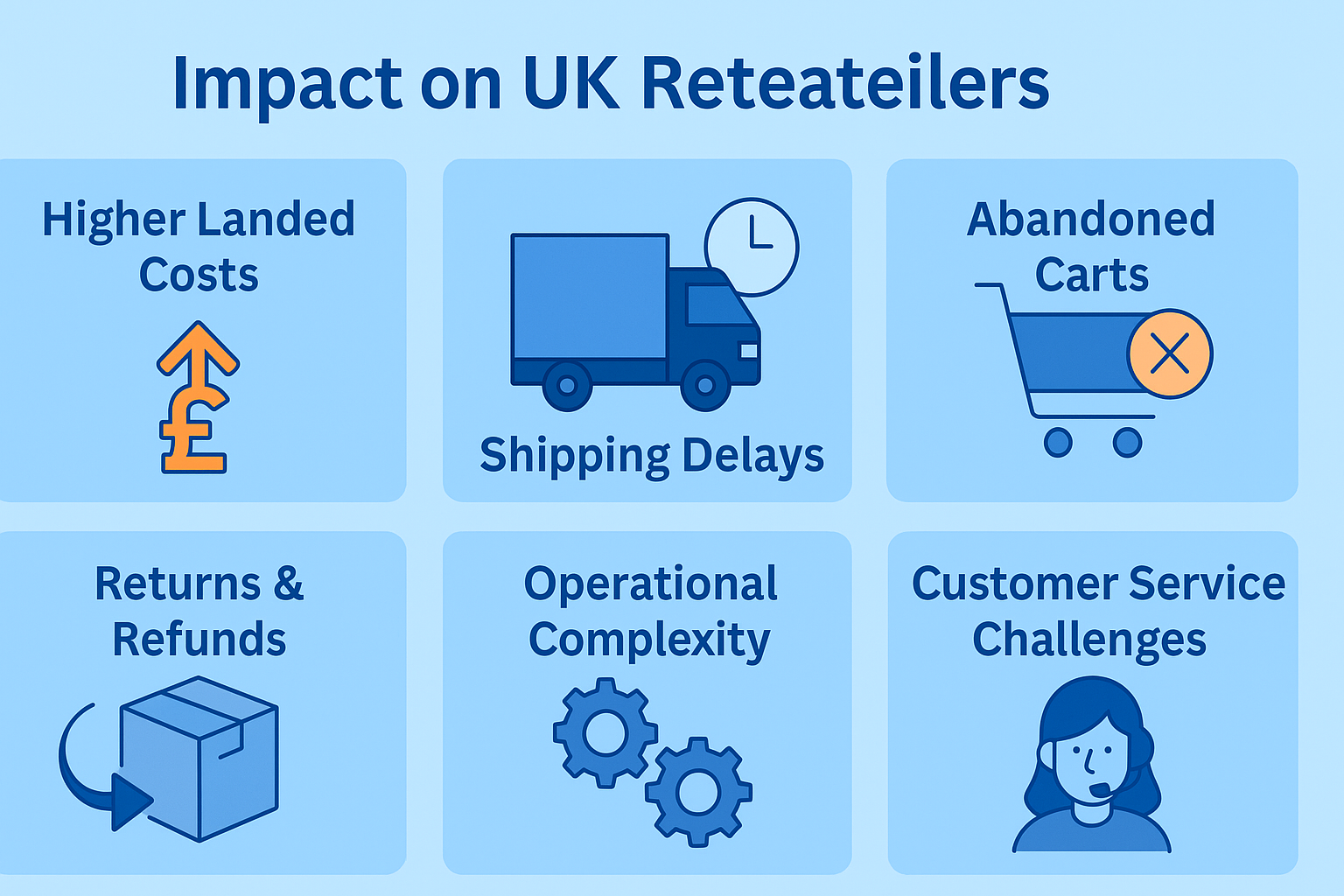
The removal of the U.S. de minimis exemption will have a direct and immediate effect on the way UK retailers manage their U.S. sales. What was once a simple, predictable process will now involve higher costs, more administration, and potentially slower delivery times. These operational shifts will influence pricing, profitability, and customer satisfaction.
Higher Landed Costs
Every shipment will now include import duty, state taxes, and clearance fees. For lower-value items, the relative increase is particularly steep. For example, a £30 skincare cream sent to the U.S. could attract $5–10 in duty, $10–20 in courier clearance fees, and local sales tax on top. The customer who previously paid only £35 delivered may now face a total closer to £50–55.
For higher-value items, the absolute duty cost is larger but the percentage impact may be easier to absorb. A £250 handbag, for example, might rise by 15–20% once duty and tax are added. Retailers will need to decide whether to absorb these costs, increase prices, or pass them directly to customers.
Shipping Delays
Without the simplified customs clearance process, parcels are likely to take longer to reach U.S. buyers. Each shipment must be declared and assessed, which could add days to delivery times. During peak seasons such as Black Friday and Christmas, congestion at customs may lead to even greater delays. Retailers used to promising five-to-seven day delivery may now have to quote 10–14 days, at least until new processes stabilise.
Conversion Rates and Abandoned Carts
Unexpected costs at checkout are one of the biggest drivers of abandoned shopping carts. With duties and taxes now unavoidable, retailers that fail to make these costs clear risk losing a significant portion of U.S. sales. Surveys suggest that up to 40% of shoppers will abandon a purchase if faced with surprise fees. Transparent pricing models—such as showing the full landed cost at checkout—will be essential.
Returns and Refunds
The new regime complicates returns. Duties and taxes paid on import are generally non-refundable unless a formal drawback claim is filed, which is rarely practical for small retailers. This means a U.S. customer who returns an item may still be out of pocket for the import charges. Unless handled carefully, this can damage trust and discourage repeat orders. Some businesses may choose to absorb these losses as part of their returns policy, while others may establish U.S. returns hubs to manage the process domestically.
Operational Complexity
Every order is now effectively a full export transaction. This adds a layer of complexity for smaller businesses unused to customs compliance. Training, new systems, and possibly new partnerships with customs brokers or third-party logistics providers will be required. The cost of managing these processes—both financially and in terms of staff time—must be factored into future planning.
In short, the operational impact of the de minimis removal extends beyond tariffs. Retailers will face increased costs, slower deliveries, and customer service challenges. How they adapt to these pressures will determine whether U.S. sales remain a profitable and sustainable part of their business model.
Sector-Specific Impacts
The end of the U.S. de minimis threshold will not affect all UK exports equally. Tariff rates, compliance requirements, and consumer expectations differ widely between product categories. Some sectors face steep new costs while others may experience only moderate changes. Below we explore the impact on the most common categories sold by UK retailers into the U.S.
Apparel and Footwear
Clothing and footwear carry some of the highest U.S. import duties. Average apparel tariffs are around 16–18%, with many items exceeding 20%. Footwear can face duties as high as 30–35%, depending on the material and style. A £90 pair of trainers could easily attract $25–30 in duty, plus clearance fees and sales tax. This makes the sector one of the hardest hit.
Additional compliance requirements include strict labelling rules covering fibre content, country of origin, and care instructions. UK retailers in the fashion sector must ensure every garment meets U.S. labelling standards to avoid delays at customs.
Beauty and Skincare
Tariffs on cosmetics and skincare are generally lower than for apparel, usually in the 4–15% range. However, regulatory compliance is a bigger concern. The U.S. Food and Drug Administration (FDA) requires all cosmetics and skincare products to meet safety and labelling standards, and imports may be inspected more frequently under the new rules.
Small UK beauty brands that previously shipped a few jars or bottles directly to U.S. customers without issue will now need to ensure that ingredients, labels, and packaging fully comply with U.S. law. For products like sunscreens or acne treatments, which are classified as over-the-counter drugs in the U.S., even stricter rules apply.
Electronics
Many consumer electronics—such as laptops, tablets, and phones—enter the U.S. duty-free. But accessories and certain categories, such as headphones or wireless devices, face duties of 5–10%. If manufactured in China, these products may also be subject to additional tariffs of up to 25%, significantly increasing costs.
Compliance is also critical. Wireless devices must be certified by the Federal Communications Commission (FCC). Products lacking the correct FCC ID may be denied entry. UK retailers selling gadgets and accessories must ensure that devices meet U.S. technical standards before shipping.
Supplements and Wellness Products
Most dietary supplements attract low or zero tariffs, but they face heavy regulatory oversight. Every shipment requires an FDA Prior Notice before arrival in the U.S. Packaging must include the correct Supplement Facts panel, and formulations must comply with FDA rules. Ingredients that are restricted or treated as drugs in the U.S. may be seized.
The financial impact comes from clearance fees and fixed postal duties. A single £20 bottle of vitamins could cost an additional $80 in duties during the postal grace period—making small, one-off orders unviable. Retailers will need to encourage U.S. customers to buy in larger quantities or consider stocking inventory in the U.S.
Other Categories
- Books: Duty-free, but still subject to clearance fees that can outweigh the product value.
- Toys: Often duty-free, but must comply with U.S. child safety regulations under CPSIA.
- Home and Kitchen Goods: Moderate duties (5–15%), with ceramics and textiles facing higher rates.
- Food and Drink: Require FDA compliance and prior notice; many products face restrictions or bans.
The overall message is clear: sectors with high tariffs and strict regulatory requirements, such as apparel, footwear, and supplements, will be most disrupted. Lower-duty sectors, such as books and toys, face fewer direct cost increases but will still need to navigate clearance fees and paperwork.
B2C vs B2B Implications
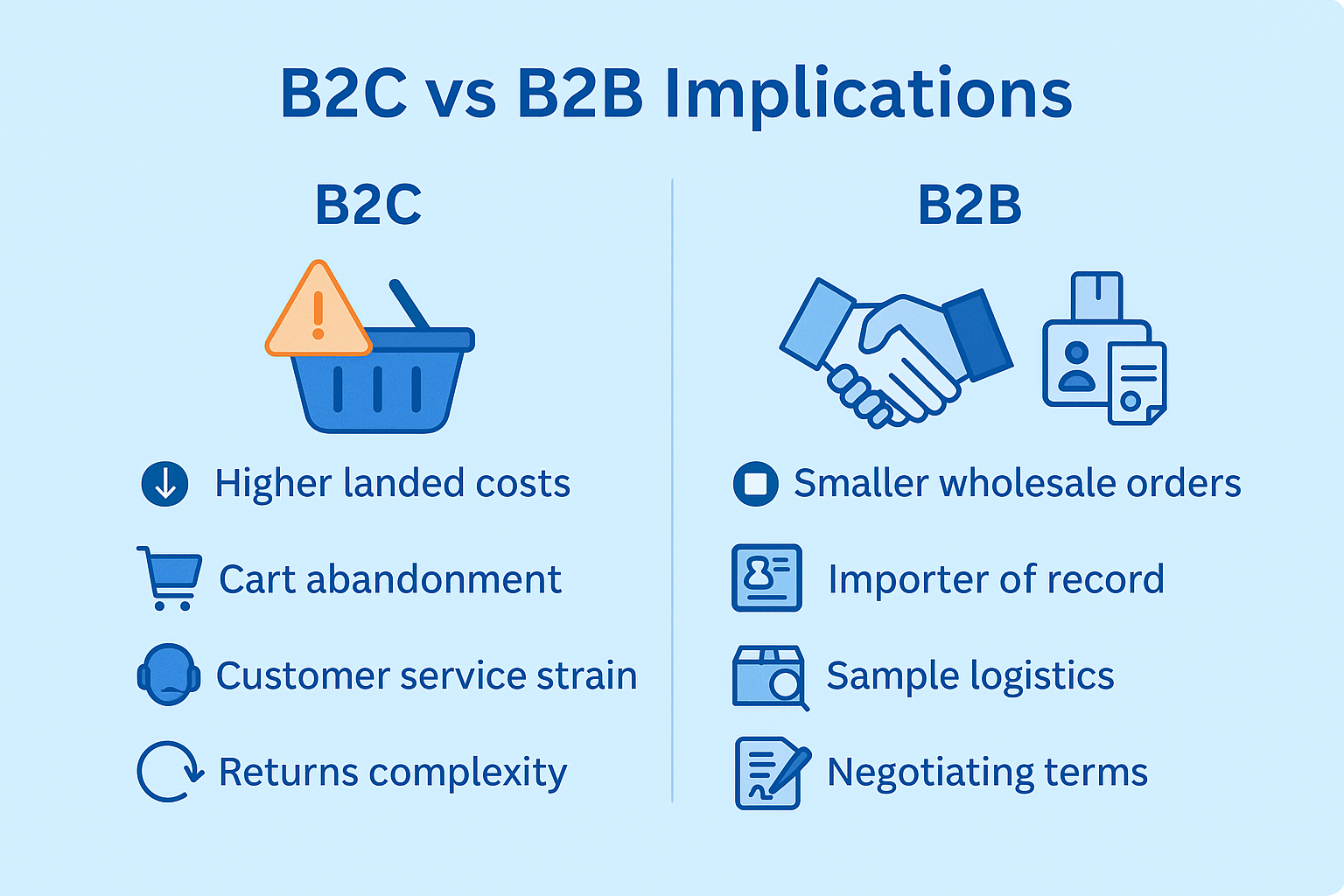
The removal of the U.S. de minimis exemption affects all cross-border sales, but the impact differs depending on whether a UK retailer is selling directly to consumers (B2C) or to other businesses (B2B). Each model faces unique challenges and requires a tailored approach.
Direct-to-Consumer (B2C)
For UK brands shipping individual orders to U.S. customers, the change is particularly disruptive. Under the old rules, a £20 T-shirt or a £30 beauty product could be sent quickly and cheaply, with no duties applied on arrival. From August 2025, those same orders will incur duties, clearance fees, and potentially longer delivery times. This has several consequences:
- Higher landed costs: Small, low-value orders become much more expensive to deliver.
- Cart abandonment: U.S. customers are more likely to abandon purchases if faced with unexpected import charges.
- Customer service strain: Queries and complaints about duties, delays, or returns will increase.
- Returns complexity: Duties paid on import are not easily refunded, complicating refund policies.
For DTC sellers, success will depend on transparent pricing, clear communication with customers, and exploring logistics models such as U.S. warehousing to reduce costs and delivery times.
Business-to-Business (B2B)
For UK manufacturers or wholesalers selling into the U.S. market, the dynamics are different. Most B2B orders already exceed the $800 threshold and therefore required formal customs entry even before the change. However, the removal of de minimis still has knock-on effects:
- Smaller wholesale orders: Test orders or sample shipments under $800 will now face duties and clearance fees.
- Importer of record: U.S. business customers may now be listed as importer of record for all orders, which can complicate relationships.
- Sample logistics: Sending prototypes or promotional items becomes more costly and administratively burdensome.
- Negotiating terms: UK exporters may need to adjust incoterms (DDP vs DAP) to remain attractive to U.S. buyers.
While B2B sellers are generally more accustomed to customs procedures, they should still review contracts, pricing, and distribution models to ensure they remain competitive in the U.S. market.
Summary
In short, B2C retailers face the steepest challenges, with higher costs per parcel and more fragile customer relationships. B2B exporters are less exposed, but must still adapt to new rules for small shipments and samples. Both groups should review their U.S. strategies now to avoid disruption when the rules change.
Adapting Your Business Strategy
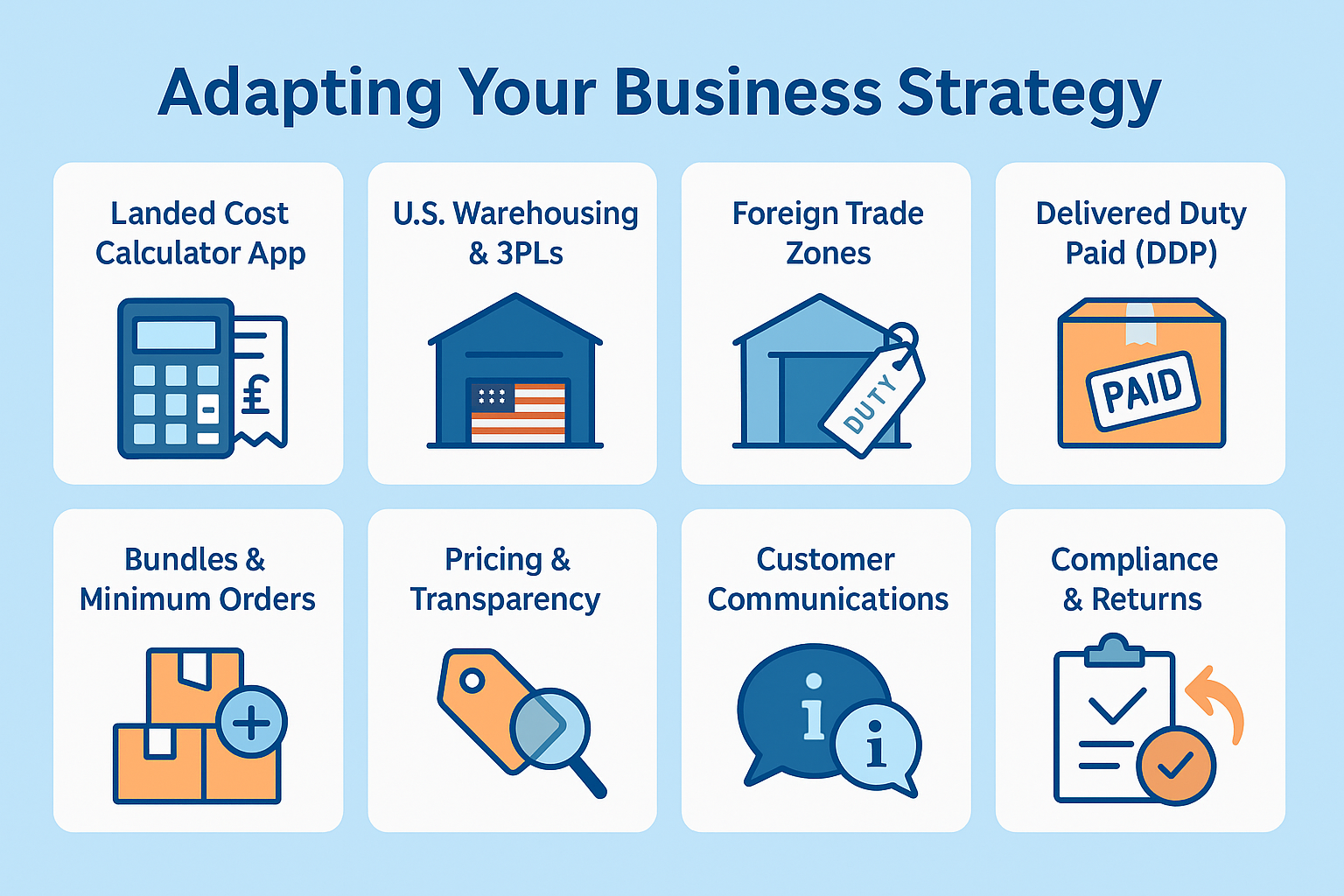
The end of the U.S. de minimis exemption is disruptive, but it does not mean UK retailers must give up on the American market. Success will come from adapting operations, pricing, and customer communication to the new reality. Below are key strategies to consider.
Upcoming Landed Cost Calculator for U.S. Shipments
On 30th July 2025, the United States announced that from 29th August 2025 it will remove its $800 de minimis exemption. To help retailers manage this change, ShopWired will be launching a new Landed Cost Calculator app. The app is designed to give both merchants and their customers full visibility of U.S. duties and taxes at checkout.
The Landed Cost Calculator will allow you to:
- Choose whether duties and taxes are mandatory for all U.S. orders or optional at checkout.
- Configure each delivery rate for eligibility under DDP (Delivered Duty Paid).
- Automatically calculate U.S. duties and taxes using your product HS codes and a new “Country of origin” setting.
- Exclude exempt products automatically based on their HS code.
- Display a clear “Duties & Taxes” line item at checkout so customers know the full cost before ordering.
- Collect payment for duties and taxes as part of the order total.
For merchants using ShopWired’s ShipStation app, the calculated duties and taxes will also be passed into ShipStation. If your courier supports DDP, those amounts will be remitted directly to U.S. Customs by the courier.
Royal Mail Click & Drop: At present, Royal Mail does not support DDP shipping to the U.S. but has announced its intention to add this functionality (see Royal Mail update). ShopWired is monitoring developments and will update our Click & Drop app as soon as support becomes available.
Availability: The Landed Cost Calculator app will be available to install in ShopWired accounts on or before 29th August 2025. Merchants not using a DDP-capable courier can still display duties and taxes for transparency, though charges will not be remitted automatically. Additional fees will apply, as calculation services will be provided through a third-party platform. A full setup guide will be published before launch.
Accounting integrations: ShopWired’s integrations with Xero, QuickBooks, Sage, Clearbooks, and Kashflow will be updated to allocate collected duties and taxes to a dedicated account code.
U.S. territories: All territories affected by these changes will be included in the app. Puerto Rico and the U.S. Virgin Islands fall within the U.S. customs zone and will be covered. Guam, American Samoa, and Northern Mariana Islands are outside the U.S. customs zone and therefore excluded.
Use U.S. Warehousing and 3PLs
Shifting from shipping individual parcels to bulk imports is one of the most effective ways to control costs. By sending inventory in bulk to a U.S. warehouse or third-party logistics provider (3PL), duties are paid once at the border, and orders can be fulfilled domestically. This reduces per-parcel costs, speeds up delivery, and improves the customer experience. Amazon FBA and independent 3PLs are popular options for smaller retailers.
Consider Foreign Trade Zones and Bonded Facilities
For larger volumes, U.S. Foreign Trade Zones (FTZs) or bonded warehouses allow goods to be stored with duties deferred until sold. Unsold items can even be re-exported without duties ever being paid. While more relevant for high-volume sellers, these facilities can improve cash flow and flexibility.
Switch to Delivered Duty Paid (DDP)
Using a Delivered Duty Paid model ensures that duties and taxes are paid upfront by the retailer or their courier partner, so parcels reach U.S. customers without unexpected charges. While this means the retailer must absorb or pass on costs at checkout, it creates a smoother buying experience and reduces abandoned carts.
Bundle and Set Minimum Order Values
Encourage customers to place larger orders so that the relative cost of duties and fees per item is reduced. This can be achieved through bundle deals, free shipping thresholds, or minimum order requirements for U.S. customers. A £20 single-item order may no longer make sense, but a £100 multi-item order might still be viable.
Review Pricing and Transparency
Update your pricing model to include duties and clearance costs where possible. Showing the full landed cost at checkout builds trust and avoids the shock of additional charges on delivery. Consider running targeted promotions for U.S. customers to offset the new costs during the transition period.
Update Customer Communications
Proactive communication is essential. Add clear information to your website, FAQs, and checkout process explaining that U.S. import duties and taxes will now apply. Reassure customers that this is a result of U.S. law, not a hidden charge by your business. The more transparent you are, the more likely customers are to accept the changes.
Invest in Compliance and Expertise
Train staff or work with customs brokers to ensure correct classification and documentation. Consider using shipping software that automatically calculates duties and generates the required customs data. Compliance mistakes can result in fines and delays, so investing in expertise will save time and cost in the long run.
Plan for Returns
Review your returns policy for U.S. customers. Duties and taxes are often non-refundable, so consider whether to absorb these costs as part of your service or set up a U.S. returns hub to handle items domestically. Clear policies will protect customer trust.
Adapting effectively requires both operational and customer-focused changes. By combining logistics upgrades, pricing adjustments, and clear communication, UK retailers can continue to thrive in the U.S. market despite the loss of de minimis.
Short-Term Actions (Before and After August 2025)
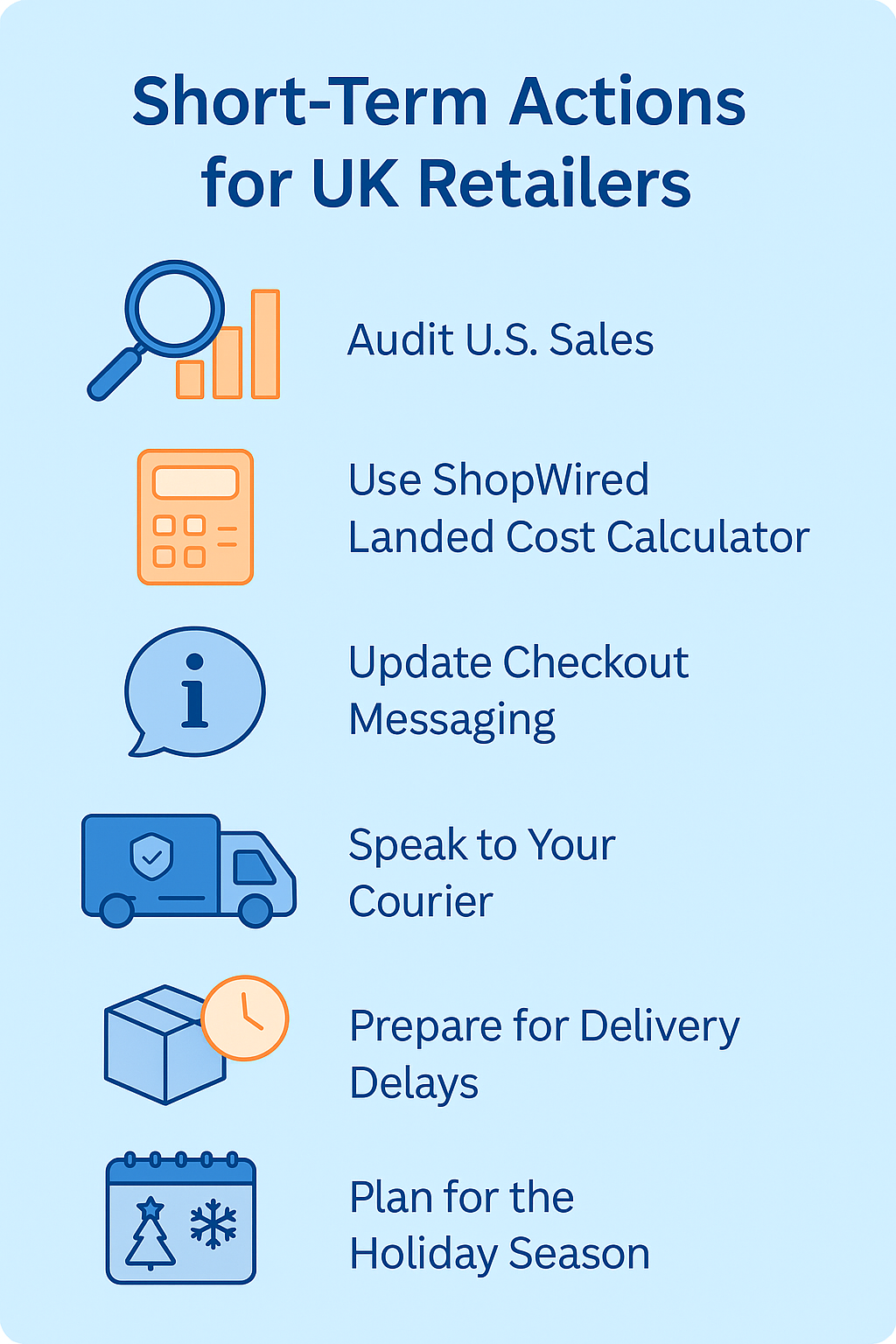
With the deadline of 29th August 2025 approaching, UK retailers selling into the U.S. must act quickly to prepare for the removal of the de minimis exemption. The following short-term actions will help minimise disruption and ensure that customers are not caught off guard by new duties and taxes.
Audit Your U.S. Sales
Begin by reviewing your current sales to the U.S. Identify which products are most popular, what their tariff classifications are, and what additional costs they will incur after the rule change. Pay close attention to low-value items that may become unprofitable once duties and fees are added.
Use the ShopWired Landed Cost Calculator App
One of the most effective immediate steps is to enable ShopWired’s new Landed Cost Calculator app. This tool allows you to automatically calculate U.S. import duties and taxes at checkout, based on your existing HS codes and a new Country of Origin setting. It ensures your customers see the full cost of their order—including duties and clearance fees—before they confirm payment.
With the app you can:
- Decide whether duties and taxes are mandatory or optional at checkout.
- Configure which delivery rates are eligible for DDP (Delivered Duty Paid).
- Show a clear “Duties & Taxes” line item on the order summary.
- Pass duty and tax amounts through to ShipStation if your courier supports DDP.
- Maintain transparency with customers, reducing abandoned carts and disputes.
ShopWired aims to have the app live in all accounts on or before 29th August 2025, giving you just enough time to configure it before the new rules come into force.
Update Checkout Messaging
Clearly inform U.S. customers that new import charges may apply. Even if you plan to use the Landed Cost Calculator app to show duties and taxes at checkout, add explanatory text to your FAQs and shipping pages. Customers should understand that this is a U.S. government policy change, not an additional fee created by your business.
Speak to Your Courier or Logistics Provider
Confirm with your courier how duties will be handled after 29th August. If you are planning to ship under a DDP model, ensure that your courier supports remitting duties to U.S. Customs. Note that Royal Mail currently does not support DDP, though they have announced their intention to add this functionality. ShopWired is monitoring Royal Mail’s updates closely and will integrate a Click & Drop solution when it becomes available.
Prepare for Delivery Delays
Build in extra time for U.S. deliveries during the first few months of the new system. Customs clearance for millions of additional parcels may create bottlenecks. Communicate revised delivery estimates on your website and order confirmations to manage customer expectations.
Plan for the Holiday Season
The fourth quarter is peak sales season, and this year it will coincide with the early months of the new U.S. customs regime. Plan early. Consider importing stock in bulk to the U.S. before November, or use a 3PL to ensure quick fulfilment during Black Friday and Christmas. Use the Landed Cost Calculator app to maintain transparency during this critical period.
Acting now—by auditing sales, enabling ShopWired’s Landed Cost Calculator app, and updating your communications—will help you transition smoothly. Retailers that wait until after the deadline risk confused customers, abandoned orders, and avoidable loss of revenue.
Longer-Term Outlook
Once the immediate disruption of the de minimis removal settles, UK retailers will face a new normal in trading with the United States. Duties, clearance fees, and customs declarations will be part of every order. The challenge is to transform these obstacles into manageable processes that allow U.S. sales to remain viable and profitable.
Shift Towards Bulk Imports and U.S. Distribution
Over the longer term, retailers with consistent U.S. demand will benefit from moving stock in bulk and fulfilling orders domestically. This approach spreads the cost of duties across larger consignments, avoids repeated clearance fees, and allows for faster delivery times. It also aligns with customer expectations for quick, reliable fulfilment.
Embedding Landed Cost Transparency
The introduction of ShopWired’s Landed Cost Calculator app is a key part of this long-term transition. Even after the first months of adjustment, retailers will need to maintain transparency with U.S. buyers. Customers increasingly expect to see the full price of their order—including duties and taxes—before clicking “buy.” Retailers that use the app to provide this clarity will stand out from competitors who still leave customers guessing about hidden charges.
Over time, this kind of visibility can build trust and encourage repeat purchases, even at higher price points. A shopper who knows exactly what they will pay is more likely to return than one who experienced an unexpected import bill on their doorstep.
Technology and Compliance Integration
Customs compliance will increasingly become part of normal e-commerce operations. Retailers can expect to integrate tools like the Landed Cost Calculator directly into checkout, accounting, and fulfilment workflows. ShopWired’s planned updates to accounting integrations—allocating duties and taxes to dedicated codes—are an example of how compliance data will flow automatically through retail systems in future.
Potential Policy Developments
Politically, there is no indication that the U.S. will reinstate the $800 exemption. In fact, the global trend is towards stricter import regimes. The UK may itself review its £135 threshold for imports. On the positive side, a future UK-U.S. trade agreement could reduce or eliminate tariffs on UK-origin goods, which would lower costs for bulk shipments. Until then, the focus for businesses should remain on operational adaptation.
Opportunities for Differentiation
Higher costs and more complex logistics will make it harder to sell low-value, commoditised products into the U.S. Instead, UK retailers may find greater success focusing on distinctive offerings—whether that’s high-quality apparel, specialist beauty formulations, or unique home goods. In these markets, customers are more willing to pay a premium, especially when duties and taxes are presented transparently at checkout.
In summary, the long-term outlook is challenging but not bleak. By combining logistics innovation, transparent pricing through ShopWired’s Landed Cost Calculator, and a sharper focus on product differentiation, UK retailers can continue to thrive in the U.S. market despite the removal of the de minimis threshold.
Expert and Trade Body Insights
The removal of the U.S. de minimis exemption has drawn strong reactions from trade bodies, advisory firms, and government departments. While the consensus is that the change will be challenging, most emphasise that with preparation, UK exporters can still succeed in the U.S. market. ShopWired’s introduction of a Landed Cost Calculator app directly addresses many of the concerns raised by these organisations.
British Chambers of Commerce (BCC)
The BCC has described the U.S. decision as a “major blow” to smaller exporters, particularly those sending low-value parcels. However, it has also stressed that opportunities remain for businesses that adapt their distribution models. The BCC advises companies to rethink sales and logistics strategies, a process made simpler by tools such as ShopWired’s Landed Cost Calculator, which provides clarity on duties and taxes at checkout.
UK Fashion & Textile Association (UKFT)
UKFT has warned that the fashion and textile sector will be heavily affected due to high U.S. tariffs on apparel and footwear. It urges members to prepare by ensuring accurate HS codes, origin documentation, and by planning for duty costs. Retailers in this sector can benefit from configuring DDP shipping within the Landed Cost Calculator app, reducing the risk of abandoned orders from U.S. customers surprised by customs bills.
British Retail Consortium (BRC)
The BRC has noted that the U.S. change adds pressure on the UK government to review its own £135 import threshold. While that debate continues, UK retailers must take practical steps to protect their U.S. sales. Transparency on costs is central to this, and the ability to display a clear “Duties & Taxes” line item at checkout through ShopWired’s new app addresses this need directly.
Advisory Firms
Advisory groups such as BDO UK have highlighted the short notice of the rule change and the significant compliance burden it creates. They recommend that retailers quickly review logistics contracts, pricing models, and customer communications. Automating landed cost calculations at checkout, as enabled by ShopWired’s app, is one of the fastest ways to implement these recommendations.
UK Government and Trade Support
The Department for Business and Trade has been in close contact with U.S. authorities to clarify implementation details and is directing businesses to guidance and training resources. While the government cannot remove U.S. duties, it supports UK retailers by ensuring they have accurate information. ShopWired complements this effort by providing practical tools—such as the Landed Cost Calculator app and updated accounting integrations—that help businesses comply with the new requirements from day one.
The overall expert view is that the U.S. policy shift will create real pressure for exporters, but it also levels the playing field internationally. UK retailers who adapt quickly and make use of tools like ShopWired’s Landed Cost Calculator will be best placed to protect their U.S. sales and build customer trust during this transition.
Checklist for UK Retailers
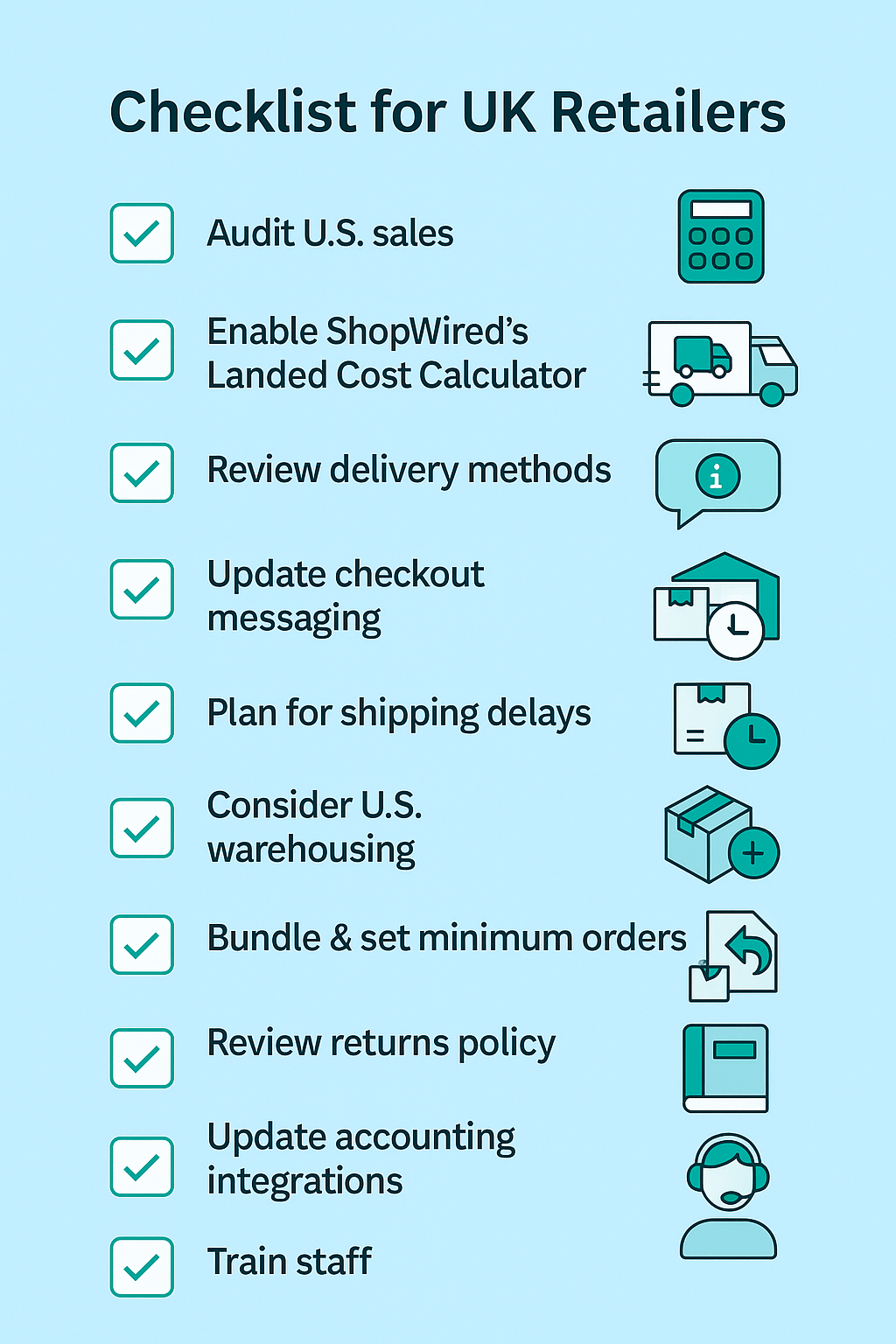
Preparing for the end of the U.S. de minimis exemption requires both operational and customer-facing changes. Use the checklist below to make sure your business is ready by 29th August 2025. ShopWired’s Landed Cost Calculator app will play a central role in many of these actions.
- Audit U.S. sales: Identify your most popular products in the U.S., confirm their HS codes, and calculate what duties and taxes will apply.
- Enable ShopWired’s Landed Cost Calculator: Install and configure the app to automatically calculate U.S. duties and taxes at checkout, show a clear “Duties & Taxes” line item, and decide whether charges are mandatory or optional.
- Review delivery methods: Confirm with your courier whether they support DDP shipping. If using Royal Mail, monitor updates on when DDP will become available.
- Update checkout messaging: Add clear information on your website and FAQ pages explaining that U.S. duties and taxes now apply. Emphasise that this is due to U.S. law, not a hidden fee from your business.
- Plan for shipping delays: Adjust your estimated delivery times to allow for customs clearance, especially during the holiday season.
- Consider U.S. warehousing: Explore bulk importing stock into the U.S. to reduce per-parcel costs and speed up delivery.
- Bundle and set minimum orders: Encourage larger baskets by offering bundles or free shipping thresholds for U.S. customers.
- Review returns policy: Decide how you will handle duties and taxes on returns and communicate this clearly to customers.
- Update accounting integrations: Ensure duties and taxes are properly recorded. ShopWired’s integrations with Xero, QuickBooks, Sage, Clearbooks, and Kashflow will allocate these amounts to a dedicated account code automatically.
- Train staff: Make sure your team understands the new customs requirements and how to handle queries from U.S. customers.
By working through this checklist and making use of ShopWired’s Landed Cost Calculator app, you can stay compliant, maintain customer trust, and protect your U.S. revenue stream after the de minimis exemption ends.
Conclusion
The removal of the U.S. de minimis exemption on 29th August 2025 marks the end of a period where UK retailers could sell to American customers with minimal friction. From this date, every parcel will be subject to import duties, taxes, and formal customs clearance. For many businesses this will mean higher costs, longer delivery times, and greater operational complexity.
Yet the U.S. remains the largest consumer market in the world and a vital destination for UK e-commerce. Retailers who adapt quickly—by auditing their U.S. sales, rethinking logistics, updating customer communications, and ensuring transparency at checkout—can continue to succeed. Those who fail to prepare risk abandoned orders, unhappy customers, and declining revenue.
ShopWired is committed to helping retailers navigate this transition. Our Landed Cost Calculator app, launching ahead of the rule change, gives you the tools to calculate U.S. duties and taxes at checkout, configure DDP shipping options, and integrate these costs into your accounting systems. Combined with updated courier integrations and guidance, this ensures that your customers know the full price of their order before they buy, protecting trust and conversion rates.
The coming months will be challenging, but they also present an opportunity for UK retailers to professionalise their U.S. sales strategy. By embracing transparency, investing in logistics solutions, and leveraging technology like ShopWired’s Landed Cost Calculator, businesses can turn disruption into competitive advantage. The U.S. market is changing—but with the right preparation and tools, it remains wide open to ambitious UK retailers.